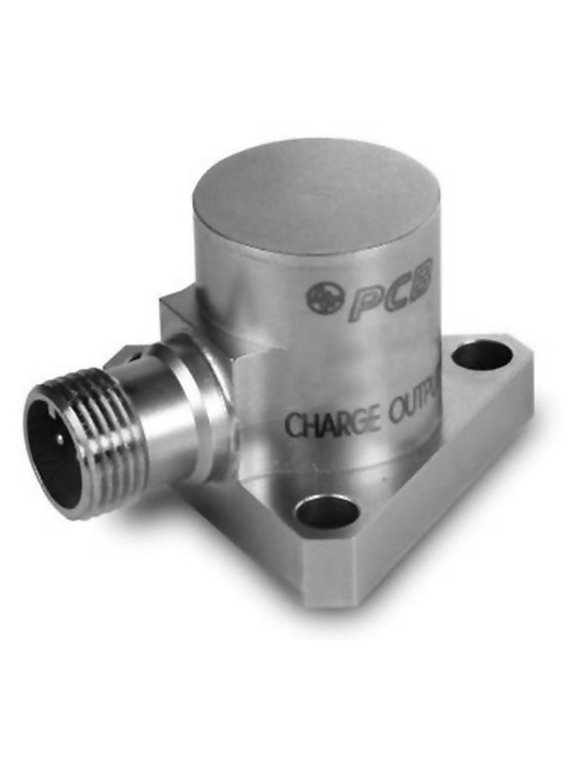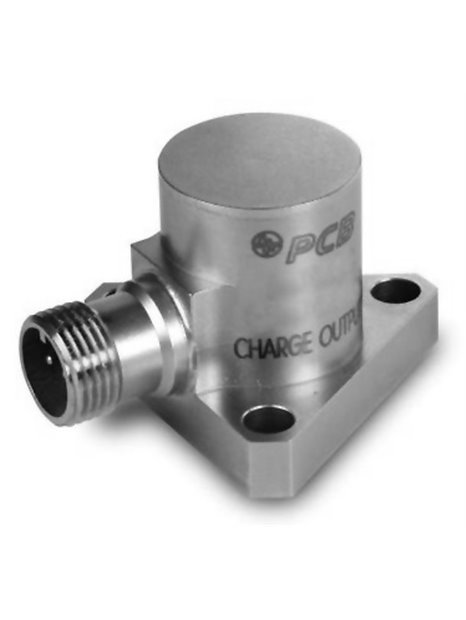
PCB-357B81
| basic data | |||
| sensitivity (±5%) | 20 pC/g | 2.04 pC/(m/s²) | |
| range | 2.000 g pk | 19.620 m/s² pk | |
| frequency range (±5%) | 9,000 Hz | ||
| Resonance frequency | ≥ 35,000 Hz | ||
| linearity error (2.000 g, 19.620 m/s²) | ≤ 1% | ||
| acceleration interference | ≤ 5% | [2] | |
| conditions | |||
| Overload limit (shock) | ±4. 000 g pk | ±39. 240 m/s² PK | |
| Temperature range (operation) | -65 … 500 ° F | -54 … 260 ° C | |
| temperature range (max) | 550 ° F | 288 ° C | |
| Strain sensitivity (footprint) | 0.004 g/µε | 0.04 (m/s²)/µε | [1] |
| maximum radiation exposure (integratedNeutron flux) | 10.000.000.000 N / cm 2 | ||
| maximum radiation exposure (integral gamma River) | 100,000,000 wheel | ||
| technical characteristics | |||
| capacity (from pin to pin) | 2,400 pF | [1] | |
| capacity (of pin housing) | 30 pF | [1] | |
| capacity ät (asymmetry between the pins) | ≤ 2 pF | ||
| insulation resistance (from pin on housing at 21 ° C) | ≥ 1 G Ω | ||
| Insulation resistance (from pin to pin at 260 ° C) | ≥ 10 M Ω | ||
| insulation resistance (from pin to pin at 21 ° C) | ≥ 1 G Ω | ||
| Insulation resistance (from pin on housing at 260 ° C) | ≥ 50 M Ω | ||
| Output polarity | differential | ||
| physical properties | |||
| sensor element | ceramic | ||
| Geometry of the sensor element | shear principle | ||
| housing material | stainless steel | ||
| Sealing | hermetically sealed | ||
| size - height | 1.00 in | 25.4 mm | |
| size ße - diameter | 0.75 in | 19 mm | |
| dimensions (maximum) | 1.75 oz | 50 grams | [1] |
| electrical connection | 7/16-27 2-pin | ||
| Connection position | side | ||
| mounting | 3 holes | ||
| notes | |||
| [1] | Typically | ||
| [2] | transverse acceleration sensitivity typically ≤ 3% | ||
| equipment | |||
| 081A99 | screw | 3 | |
| ACS-1 | frequency response, traceable to NIST (10 Hz up to the upper 5% point) | -1 |

PCB-357B81