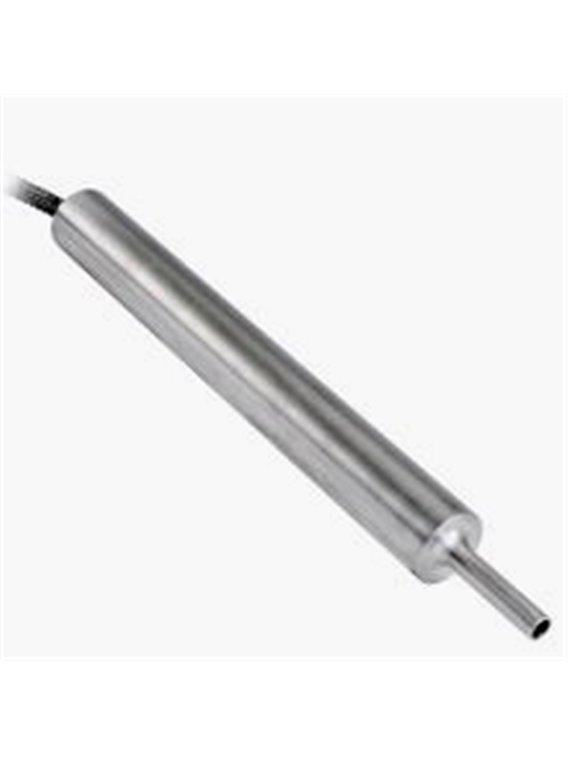
PCB-176M12
- Pressure sensor with charge output for detecting combustion instability in turbines,
- With ATEX / CSA approval,
- Continuous use temperature up to 530 ° C,
- With UHT-12™ sensor element,
(no popcorn noise), - Measurement range 1.4 bar,
- Sensitivity 247 pC/bar,
- Frequency range up to 1500 Hz,
- Integrated hardline cable,
ending on 7/16-27-connector
| specifications | |||
|---|---|---|---|
| Basic data | English units | SI units | |
| sensitivity (±20%) | 17 pC/psi | 247 pC/bar | |
| measuring range | 20 psi | 1,4 bar | |
| Maximum pressure (total) | 400 psi | 27.6 bar | |
| resonance frequency | > 30,000 Hz | ||
| transverse resonance | ≥3.000 Hz | ||
| Upper frequency limit | 1500 Hz | [2] [3] [4] | |
| linearity | ≤1% FS | [1] | |
| conditions | |||
| acceleration sensitivity | ≤0,01 psi/g | ≤0,00069 bar / g | |
| Temperature range (operation) | -94... 986 ° F | -70... 530 ° C | |
| temperature range (connector) | -76... 500 ° F | -60... 260 ° C | |
| effect of temperature | [5] | see graph below | |
| approval for hazardouse atmospheres | see manual | ||
| maximum exposure to radiation (integrated gamma flux) | 100,000,000 wheel | ||
| maximum radiation exposure (integrated Neutron flux) | 10.000.000.000 N / cm² | ||
| technical features | |||
| output polarity | differential | ||
| capacity (with cable from pin to pin ) | < 165 pF | ||
| internal resistance (at room temperature) | ≥1.000.000 MΩ | ||
| insulation resistance (at room temperature) | ≥1.000.000 MΩ | ||
| Internal resistance (at 530 ° C) | ≥50 kΩ | ||
| insulation resistance (at 530 ° C) | ≥100 kΩ | ||
| physical properties | |||
| Sensor element | UHT-12™ | ||
| geometry of the sensor element | compression principle | ||
| housing material | nickel alloy | ||
| Sealing | hermetically sealed welded | ||
| wiring | 2-pin connector with7/16-27 thread | ||
| Cable type | Hardline cable with braided shield | ||
| Weight (with cables) | 11.1 oz | 315 grams | |


[6]
| Notes | |||
|---|---|---|---|
| [1] | Zero-balance just, determined using the method of least squares | ||
| [2] | Calculated on the basis of acoustic resonance | ||
| [3] | The lower cut-off frequency depends on the used signal conditioning electronics. | ||
| [4] | Upper frequency limit is calculated on the basis of the resonance frequency | ||
| [5] | Typically | ||
| [6] | Details: See PCBs Declaration of conformance PS058 | ||

PCB-176M12